Press Enter go to main content

The Entire World Should Know About Green Chemistry

  • Department:Comprehensive Planning Division

 A better quality of living through Green Chemistry

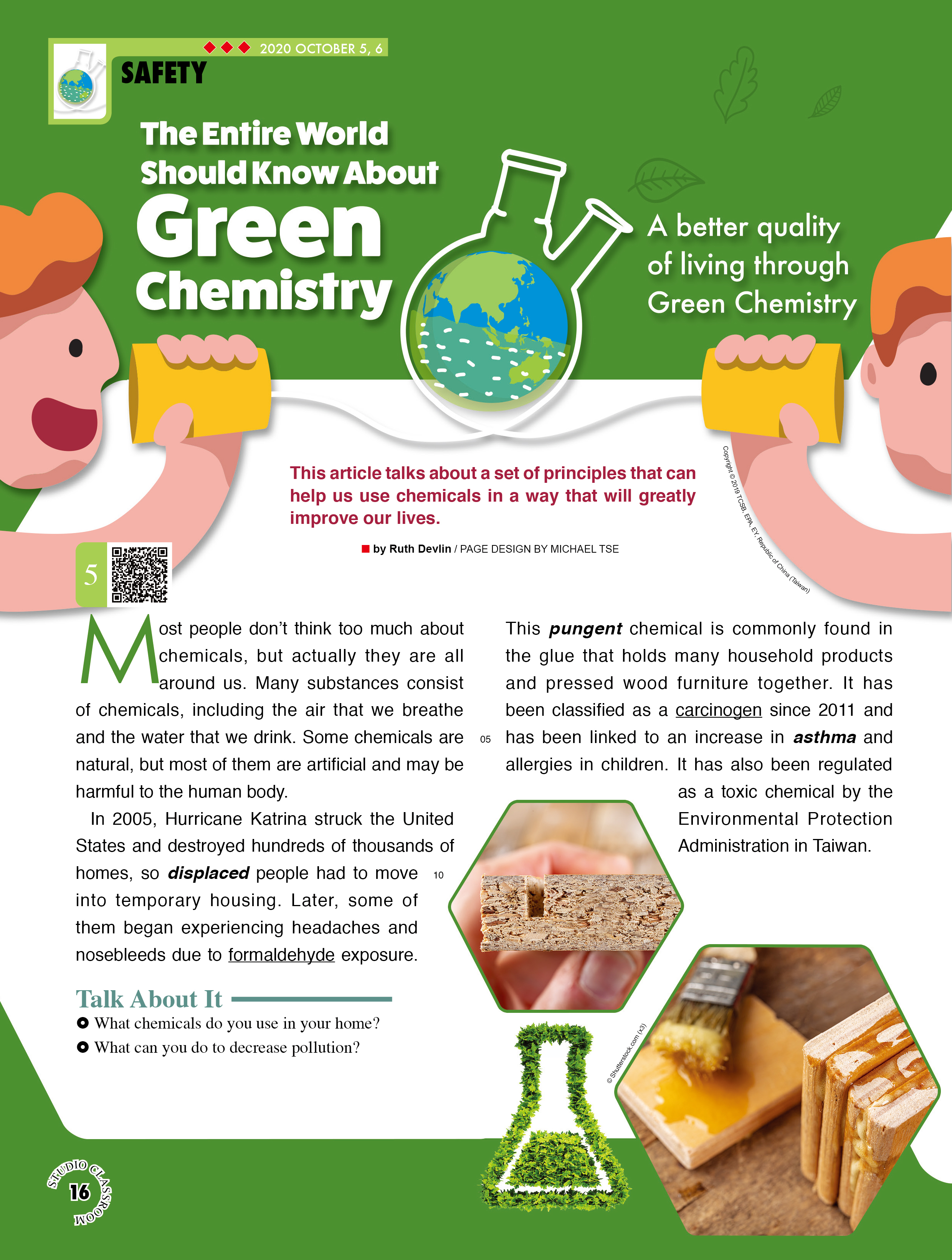
  Most people don’t think too much about chemicals, but actually they are all around us. Many substances consist of chemicals, including the air that we breathe and the water that we drink. Some chemicals are natural, but most of them are artificial and may be harmful to human body.

   In 2005, Hurricane Katrina struck the United States and destroyed hundreds of thousands of homes, so displaced people had to move into temporary housing. Later, some of them began experiencing headaches and nosebleeds due to formaldehyde exposure. This pungent chemical is commonly found in glue that holds many household products and pressed wood furniture together. It has been classified as a carcinogen since 2011 and has been linked to an increase in asthma and allergies in children. It has also been regulated as a toxic chemical by the Environmental Protection Administration in Taiwan.

However, there is another choice: natural adhesive. In particular, one made from soy proteins that have been modified to resemble the protein that some shellfish use to stick to rocks. A natural adhesive is now widely used in composite wood products in the U.S. Other companies are also developing more natural alternatives to hazardous industrial chemicals. This is a part of the Green Chemistry philosophy.

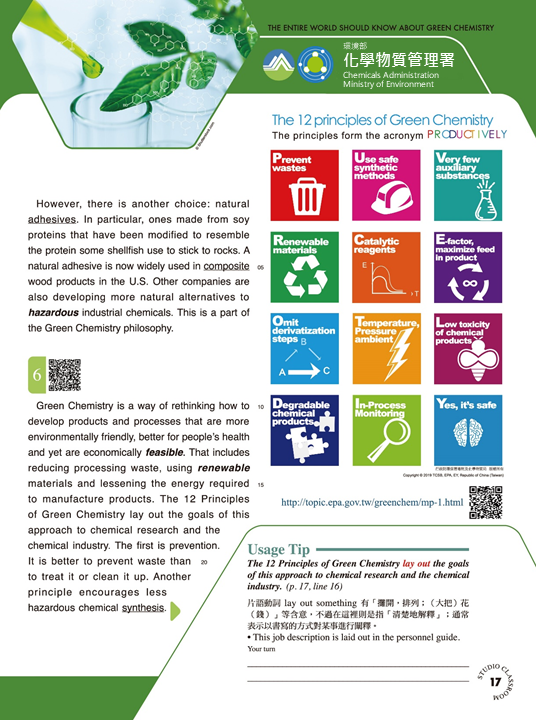
  Green Chemistry is a way of rethinking how to develop products and processes that are more environmentally friendly, better for people’s health and yet are economically feasible. That includes reducing processing waste, using renewable materials and lessening the energy required to manufacture products. The 12 Principles of Green Chemistry lay out the goals of this approach to chemical research and the chemical industry. The first is prevention. It is better to prevent waste than to treat it or clean it up. Another principle encourages less hazardous chemical synthesis. Chemical reactions should be designed to be as safe as possible. Energy efficiency is encouraged as well as using chemicals made from renewable plant-based sources rather than petrochemical ones. Attention also needs to be paid to monitoring pollution in real time and choosing and developing chemical procedures that are safer and that minimize the risk of accidents.

  There are challenges in meeting and holding to the principles of Green Chemistry, but this will spur new research and inspire the discovery of new chemistry. Green Chemistry can decrease pollution and increase the sustainable development of the earth, thus improving the quality of life for humans and animals for years to come.
Green chemistry poster introducing the principles of green chemistry
The Entire World Should Know About Green Chemistry
This poster promotes green chemistry and explains that a better quality of life can be achieved through Green Chemistry. The main article text discusses how chemicals are all around us, including in the air we breathe and the water we drink, and notes that some chemicals are natural while many are synthetic and may harm the human body. It gives the example of formaldehyde exposure after Hurricane Katrina and explains that formaldehyde has been classified as a carcinogen and linked to asthma and allergies in children. The poster also visually highlights green chemistry themes with a globe inside a laboratory flask, two children holding yellow megaphones, and images of household wood products and a plant-shaped flask to suggest safer, cleaner chemical use.
The 12 principles of Green Chemistry infographic
The 12 Principles of Green Chemistry
This infographic presents the 12 Principles of Green Chemistry, with the acronym PRODUCTIVELY. The principles are shown in a grid of colorful square icons. They include: prevent waste, use safe synthetic methods, use very few auxiliary substances, renewable materials, catalytic reagents, e-factor and maximize feed in product, omit derivatization steps, temperature and pressure ambient conditions, low toxicity of chemical products, degradable chemical products, in-process monitoring, and "yes, it's safe." The poster also includes a short article explaining that natural adhesives can be an alternative to hazardous industrial chemicals, and that green chemistry encourages product and process design that is environmentally friendlier, more feasible, and less hazardous. A QR code and reference link appear near the lower right, and the overall design emphasizes practical applications of Green Chemistry in daily life and industry.
Green Chemistry article page discussing safer chemical design and sustainability
Green Chemistry Principles in Daily Life
This article explains that chemical reactions should be designed to be as safe as possible. It encourages energy efficiency and the use of renewable, plant-based raw materials instead of petrochemical ones. The text also stresses real-time pollution monitoring and the development of safer chemical procedures that reduce the risk of accidents. The article notes that meeting Green Chemistry goals can inspire new research, improve product development, and support sustainable development. It also says Green Chemistry can decrease pollution and improve the quality of life for humans and animals. The page includes vocabulary definitions, a key points section, a QR code, and illustrations showing plants, a globe, and eco-friendly imagery.

Attachment(s) for download

Attachment download list, including file name, file size and download count
File name File size Downloads
Green Chemistry.pdf 3 MB 1,118
Share
  • facebook
  • line
  • Count Views:5,011
  • Release Date:2021-04-16
  • Update:2026-10-19
Go BackGo Top